All posts by My Gospel Soul

My Gospel Soul Magazine is a faith-driven gospel media platform founded to share inspiring testimonies, celebrate everyday heroes, and spread the message of Christ to encourage faith, hope, and purpose in readers’ lives. Rooted in gospel culture and storytelling, the magazine highlights uplifting stories from the Christian community, gospel music insights, personal reflections, and spiritual encouragement designed to edify believers and connect audiences with meaningful, faith-centered content. Led by founder Jennice Jackson, My Gospel Soul also extends its reach through podcasts and digital content that support believers in their walk with God and celebrate the transformative power of the gospel.

Lasted from The Reunion Project

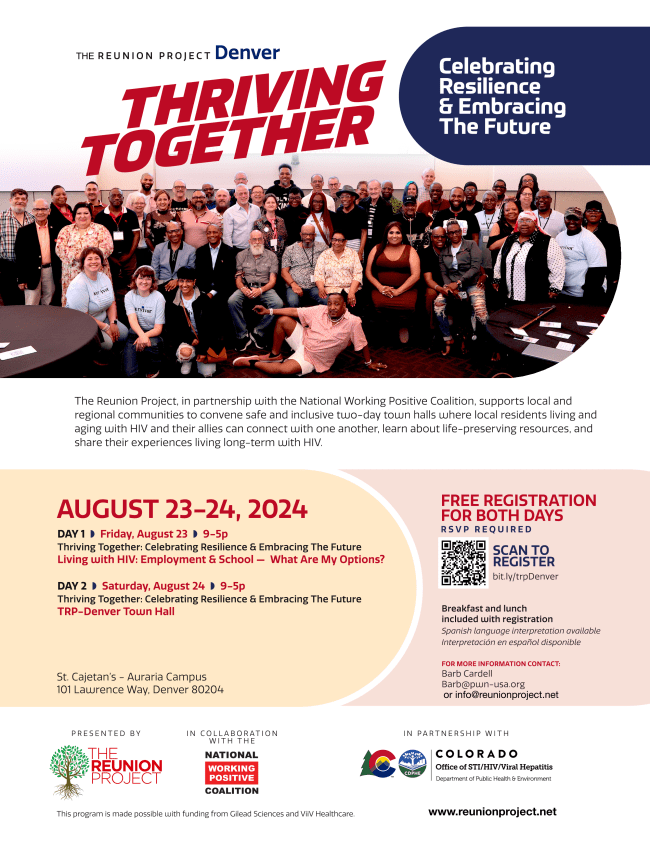
The Reunion Project, the national alliance of HIV long-term survivors, will be hosting a two-day town hall in Denver, Thriving Together: Celebrating Resilience & Embracing the Future, on August 23-24, 2024. This peer-led town hall will take place at St. Cajetan’s – Auraria Campus, 101 Lawrence Way, Denver, 80204.

The first day of The Reunion Project—Denver, Friday, August 23, will focus on employment and benefits for people living with HIV, produced in partnership with the National Working Positive Coalition. 

Saturday, August 24, will feature a mix of facilitated discussions, presentations, and networking opportunities, all aimed at addressing the unique needs of long-term survivors and people aging with HIV in Colorado.

 featured speaker on Saturday, Aug. 24 is Kristine Erlandson, MD, Professor of Medicine-Infectious Disease, University of Colorado School of Medicine. Dr. Erlandson’s research focuses on the complications of aging, understanding the mechanisms of successful aging, and implementing interventions to ensure successful aging among persons living with HIV. 

Activities on both days will be held between 9am-5pm MT with sessions and community discussions addressing the health, wellness, and employment concerns of all individuals living and aging with HIV in the Denver area and the state of Colorado.

The event is free, and breakfast and lunch are provided for those who pre-register.

Click the following link to register for Day 1 and 2 of the town hall: bit.ly/trpDenver. Be sure to register for each day you plan to attend, and stay tuned for more updates to the program!

For more information and details about the peer-led Thriving Together: Celebrating Resilience & Embracing the Future two-day town hall go to reunionproject.net/calendar.

We look forward to seeing you in Denver on August 23-24!

Medical Monitoring Project

Yesterday, the Centers for Disease Control and Prevention (CDC) published data from the 2022 cycle (June 2022–May 2023) of the Medical Monitoring Project (MMP). MMP is an annual, cross-sectional complex sample survey that reports nationally representative estimates of behavioral and clinical characteristics of adults with diagnosed HIV infection in the United States. This report provides information critical for achieving national HIV-related goals, including data used to monitor five National HIV/AIDS Strategy (2022-2025)(NHAS) quality of life indicators and HIV stigma.

Having a high quality of life is important for people with HIV. Physical health, mental or emotional health, subsistence needs—such as housing, employment, and food security—and HIV stigma can all affect quality of life. The latest MMP report shows that more work is needed to meet NHAS goals for quality of life and HIV stigma:

  • The percentage of people with diagnosed HIV who reported good or better health was 72% in 2018 and 70% in 2022 (2025 NHAS goal  95%).
  • The percentage of people with diagnosed HIV who had an unmet need for mental health services was 24% in 2017 and 27% in 2022 (2025 NHAS goal 12%).
  • The percentage of people with diagnosed HIV who experienced unstable housing or homelessness was 21% in 2018 and 18% in 2022 (2025 NHAS goal 11%).
  • The percentage of people with diagnosed HIV who reported unemployment was 15% in 2017 and 11% in 2022 (2025 NHAS goal 8%).
  • The percentage of people with diagnosed HIV who reported hunger or food insecurity was 21% in 2017 and 19% in 2022 (2025 NHAS goal 11%).
  • HIV stigma was measured with a score ranging from 0 (indicating no stigma) to 100 (indicating high stigma). Based on the score, the median HIV stigma score was 31 in 2018 and 29 in 2022 (2025 NHAS goal 16).

Despite areas of progress in recent years, more must be done to reach the 2025 NHAS goals. CDC continues to work with state and local partners to improve the reach of HIV prevention programs and services that can reduce HIV stigma and improve quality of life for people with HIV. 

For more information on these findings from MMP, please see the full report and key findings.

No Longer a Death Sentence… Listen in and Leave a Comment


It’s important to know the history and how it affects us. What was it then and what it is now!!!

KEY POINTS

  • HIV is a virus that attacks the body’s immune system.
  • The only way to know if you have HIV is to get tested.
  • There are many ways to prevent HIV, like using PrEP, PEP, condoms and never sharing needles.
  • HIV treatment helps people live long, healthy lives and prevents HIV transmission.